Replaces






Part Details
About TRQ:
TRQ is a trusted brand dedicated to making every repair a success story by combining premium parts with easy installation. Each TRQ part is engineered by a team of automotive experts to meet or exceed OEM standards, delivering enhanced performance and maximum longevity. With rigorous in-house testing, the brand ensures superior fit and function across every product line. TRQ also provides customers with best-in-class, step-by-step installation videos—so you can complete repairs with confidence, whether you're a first-time DIYer or an industry professional.
Product Features
TRQ suspension kits are manufactured using premium raw materials and coatings for extended service life. Each TRQ suspension component is designed to be a direct, maintenance-free replacement to the stock unit. To extend the life of your steering and suspension components, TRQ recommends replacing components in pairs, sets, or kits. All products are fit and road-tested in our Massachusetts R&D facility to ensure we deliver on our promise of Trusted Reliable Quality.
Our direct fit gas-charged shock absorbers help restore your vehicle's handling and ride quality to just like new.
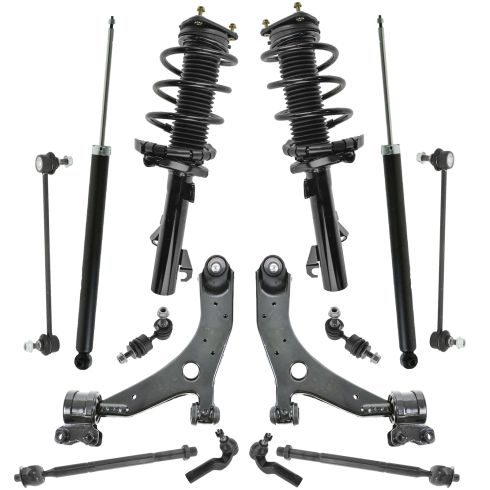
Replacing struts used to require specialized tools to compress, remove, and transfer the old spring and mount. Our Pre-assembled, complete strut & spring assemblies come with all new parts and make the job much quicker and easier for the do-it-yourself mechanic.
Strut & spring assembly contains:
Install Tip: When replacing steering components, have a professional alignment performed afterwards. This ensures proper tracking and even tire wear.
Our steering and suspension components are pre-greased and sealed for long life and do not require the extra maintenance typically required by greaseable versions.
Attention California Customers:
 WARNING: This product can expose you to chemicals including Chromium (Hexavalent Compounds), which is known to the State of California to cause cancer, and birth defects or other reproductive harm. For more information, go to www.P65Warnings.ca.gov
Lifetime Warranty
This item is backed by our limited lifetime warranty. In the event that this item should fail due to manufacturing defects during intended use, we will replace the part free of charge. This warranty covers the cost of the part only.
FREE Shipping is standard on orders shipped to the lower 48 States (Contiguous United States). Standard shipping charges apply to Hawaii and Alaska.
Shipping is not available to a P.O. Box, APO/FPO/DPO addresses, US Territories, or Canada for this item.
Expedited is available on checkout to the United States, excluding Alaska, Hawaii.
Final shipping costs are available at checkout.
Created on:
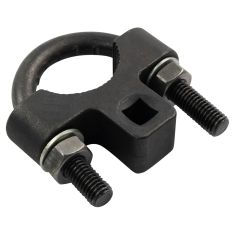
Tools used
Brought to you by 1AAuto.com, your source for quality replacement parts and the best service on the internet. Hi, I'm Don from 1A Auto. I hope this helpful video helps you out. The next time you need a part for your vehicle, think of 1AAuto.com. Thanks.
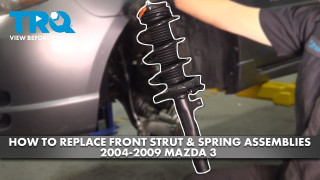
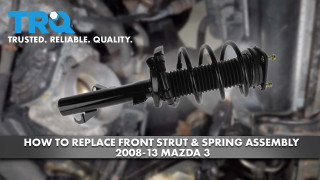
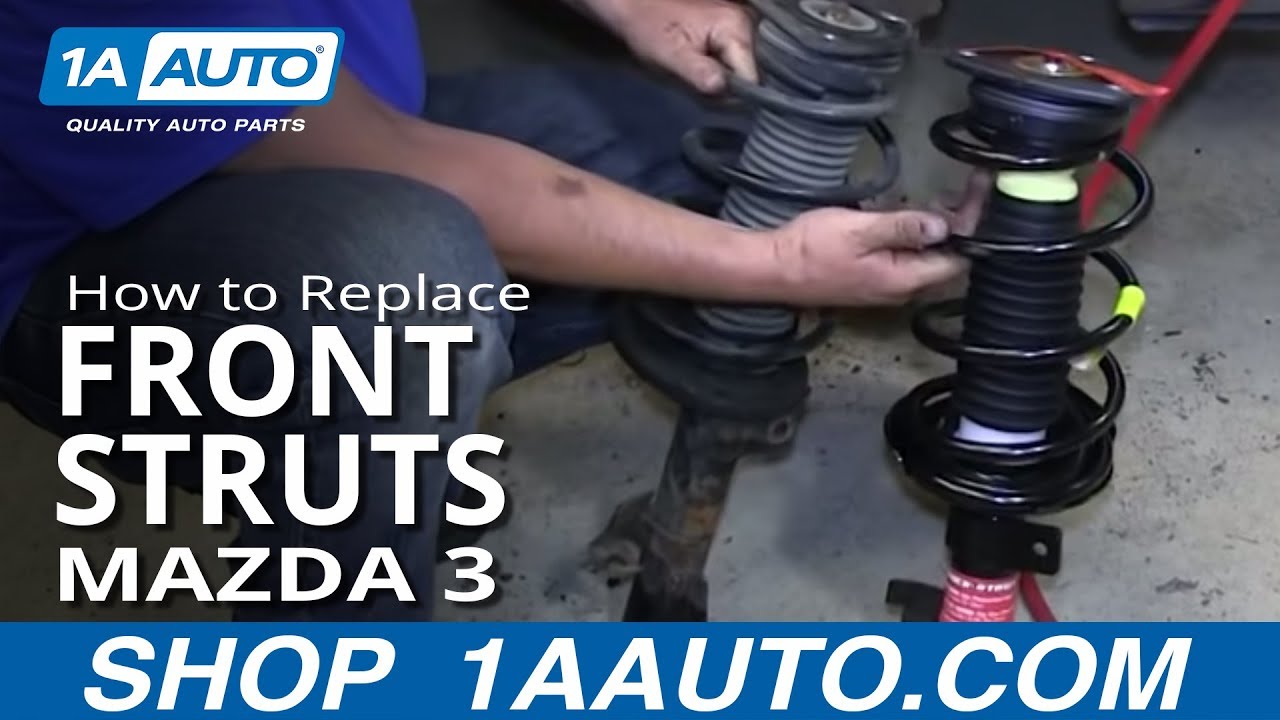
In this video, we're going to be showing you how to replace the front struts on this 2007 Mazda 3 series. We'll show you the right hand side, left hand side is the same procedure and obviously we always recommend that you replace your struts in pairs. You'll need a new set of loaded struts from 1AAuto.com, jack and jack stands, 13 to 19mm sockets, ratchets and a breaker bar or pipe for some extra leverage, a couple of the bolts are pretty tough, flat blade screwdriver, locking pliers, a large hammer, 5 or 10 pound sledge, penetrating oil and a torque wrench.
Start off by removing your wheel and tire. There will be a hub cap so you'll remove the hub cap first. We have the benefit of air tools. If you're not using air tools, you'll want to loosen the lug nuts with the vehicle on the ground first then raise and support the vehicle and remove the lug nuts wheel and tire. We're going to apply some penetrating oil to the bolt that holds the lower strut and as well as the upper bolt for the stabilizer link. There is a clip that holds the break hose into the strut, now use a screw driver to pry that clip out. You can pry from the side first and then kind of pry up from below and pull the clip out.
Once you remove the clip, just pull the hose free. Now, take a pair of vise grip or locking pliers and lock it onto the back side of the stabilizer shaft and then there's a 14mm bolt and remove that with a 14mm socket and ratchet. Now, there's a 17mm bolt that holds the steering knuckle to the strut. You see I'm using a 17mm socket and ratchet and a pipe for some extra leverage to loosen up that bolt. You need to make sure that you spray that bolt with a lot of penetrating bolt beforehand to help this process along. Okay, we just shed that extra pipe and removed the bolt the rest of the way.
I'm going to coat with penetrating oil around the bottom of the strut where it goes with the steering knuckle and then use a nice, big sledge hammer and just hit the steering knuckle directly at first. Once you get it to move then put a piece of wood in just so you don't do too much damage to the steering knuckle and use the wood to hammer it the rest of the way off. There are three 14mm bolts that hold the strut in at the top, remove those. One note as we fast forward here, you want to remove two of the bolts and then just loosen up one of the bolts most of the way. You want to leave one bolt intact.
Okay, with one bolt still up top installed, push down on the steering knuckle and break the bottom free. Now, finish removing that top bolt and bring the strut down and out. Old strut on the left, new strut from 1A Auto on the right. You can see all the mounting points are the same. It's going to install just the same. Okay, ready to install the new strut. There's the stabilizer link mount that goes right to the back, easy way to line it up. Put the strut up in and then start one of the bolts on. It's just a matter of lining it up. Once you have one of the bolt holes lined up then start the bolt on. Once you get one, you can start the other two. Now, just fast forward. We're not tightening them up all the way, we're just kind of preliminarily tightening them up.
Now, we're ready to put the bottom back together, put some penetrating oil or grease in then in hope to get things together. Push the steering knuckle down. Line them up with a strut and push it in. Once you started, put a floor jack underneath the spindle and jack it up and that will force the spindle or the steering knuckle up onto the strut. Now, you can put the bolt through. It will only go through if the strut is together enough. We'll fast forward here as we just preliminarily turn or preliminarily tighten that bolt up. Now, we'll use a torque wrench and tighten that bolt up to 80 foot pounds.
Bring the hose down, feed it through and back and up into position and put the clip back in place. Then fast forward here as we put that stabilizer link back in place. Thread the nut on, put the locking pliers on the back side and tighten it up, get it nice and tight, you want it anywhere from 50 to 60 foot pounds. Then keep the speed going here as we put the wheel and tire back on. Thread the log nuts on and tighten them up preliminarily. Okay, and back on the ground we've tighten the log nuts to 100 foot pounds using a star pattern. Reinstall the wheel cover noting the position of the valve stem.
Now, we're going to tighten and torque the upper bolts to 25 foot pounds and repeat all that for opposite side and we should be all set with nice new struts.
We hope this helps you out. Brought to you by www.1AAuto.com, your source for quality replacement parts and the best service on the internet. Please feel free to call us toll-free, 888-844-3393. We're the company that here for you on the internet and in person.
Tools used
Hi, I’m Mike from 1A Auto. We’ve been selling auto parts for over 30 years!
Hey everyone, Sue here at 1A Auto. And today we're installing outer tie rod ends on our '07 Mazda 3 sedan. These came from 1A Auto, so if you need this part or any other part for your car, click on the link below and head on over to 1A Auto.
Keep in mind before this repair, set up an appointment with your local alignment shop and you're going to need an alignment afterwards.
We're going to loosen the lug nuts with the weight of the car on the tire and it's a 21 millimeter. Now you're going to raise the vehicle with a jack and jack stands or a two post lift if you have that. Now I can take the lug nuts off. It's up in the air.
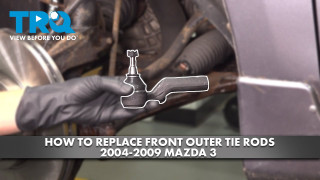
This is the inner tie rod end. It has a bellow boot that covers the end that screws into the power steering rack, and this is your outer tie rod end. This is a jam nut. This is where adjustments are made for a tow on a car. I'm going to start by spraying the jam nut and the upper part of the outer tire rod end. Let that soak. I'm going to break the jam nut free first. It's a 24 millimeter on this Mazda 3. Now that's broken free and spinning I have to undo the top nut to the outer tie rod end, take this cotter pin out. We discard it because we're going to use a new one. The nut is a 14 millimeter socket. It's kind of rusted so just wiggle it on down there. I'm going to break it free. Now I'm going to take a hammer and hit the end of the knuckle where the tie rod end goes in to pop the stud out.
Here we have outer tie rod ends on our '07 Mazda 3 sedan. This one is from 1aauto.com, and this is the one we took out. The one from 1aauto.com is stamped clearly, R for right side, the passenger side, comes with its own new castle nut and a cotter pin. If you need this part or any other part for your car, click on the link below and head on over to 1aauto.com.
Now I'm just going to put some anti-seize on the threads. Now install the outer tie rod end. Thread it on up to the jam nut. I'm going to bring it up, put it in the knuckle, install my castle nut. The new one is a 16 millimeter socket. There is no torque for this. I just really want it down tight. There we go.
Now I can install my cotter pin. Just fold that over. That just stops the nut from possibly on back threading out. I like to squeeze all sharp edges down, only fair to somebody. Now we're going to take our wrench and tighten up the jam nut. You want that snug right down because you do have to drive it to the alignment shop. That's a 24 millimeter wrench, same as the old one. There we go. Once I lower this to the ground always tighten wheels in a star pattern. And our wheel torque on our '07 Mazda 3 is 87 foot-pounds. Always go around twice.
Thanks for watching. Visit us at 1AAuto.com for quality auto parts, fast and free shipping, and the best customer service in the industry.
Tools used
Tools used
Hi, I’m Mike from 1A Auto. We’ve been selling auto parts for over 30 years!
Hey everyone, Sue here at 1A Auto. And today we're installing outer tie rod ends on our '07 Mazda 3 sedan. These came from 1A Auto, so if you need this part or any other part for your car, click on the link below and head on over to 1A Auto.
Keep in mind before this repair, set up an appointment with your local alignment shop and you're going to need an alignment afterwards.
We're going to loosen the lug nuts with the weight of the car on the tire and it's a 21 millimeter. Now you're going to raise the vehicle with a jack and jack stands or a two post lift if you have that. Now I can take the lug nuts off. It's up in the air.
This is the inner tie rod end. It has a bellow boot that covers the end that screws into the power steering rack, and this is your outer tie rod end. This is a jam nut. This is where adjustments are made for a tow on a car. I'm going to start by spraying the jam nut and the upper part of the outer tire rod end. Let that soak. I'm going to break the jam nut free first. It's a 24 millimeter on this Mazda 3. Now that's broken free and spinning I have to undo the top nut to the outer tie rod end, take this cotter pin out. We discard it because we're going to use a new one. The nut is a 14 millimeter socket. It's kind of rusted so just wiggle it on down there. I'm going to break it free. Now I'm going to take a hammer and hit the end of the knuckle where the tie rod end goes in to pop the stud out.
Here we have outer tie rod ends on our '07 Mazda 3 sedan. This one is from 1aauto.com, and this is the one we took out. The one from 1aauto.com is stamped clearly, R for right side, the passenger side, comes with its own new castle nut and a cotter pin. If you need this part or any other part for your car, click on the link below and head on over to 1aauto.com.
Now I'm just going to put some anti-seize on the threads. Now install the outer tie rod end. Thread it on up to the jam nut. I'm going to bring it up, put it in the knuckle, install my castle nut. The new one is a 16 millimeter socket. There is no torque for this. I just really want it down tight. There we go.
Now I can install my cotter pin. Just fold that over. That just stops the nut from possibly on back threading out. I like to squeeze all sharp edges down, only fair to somebody. Now we're going to take our wrench and tighten up the jam nut. You want that snug right down because you do have to drive it to the alignment shop. That's a 24 millimeter wrench, same as the old one. There we go. Once I lower this to the ground always tighten wheels in a star pattern. And our wheel torque on our '07 Mazda 3 is 87 foot-pounds. Always go around twice.
Thanks for watching. Visit us at 1AAuto.com for quality auto parts, fast and free shipping, and the best customer service in the industry.
Tools used
Hi, I’m Mike from 1A Auto. We’ve been selling auto parts for over 30 years!
Hi everyone, this is Sue from 1A Auto. Today we're installing an inner tie rod end from 1A Auto on our '07 Mazda 3 sedan. If you need this part or any other part for your car, click on the link below and head on over to 1AAuto.com.
Keep in mind, before this repair, set up an appointment with your local alignment shop, and you're going to need an alignment afterwards. We're going to loosen the lug nuts with the weight of the car on the tire, and it's a 21 millimeter. Now you're going to raise the vehicle with a jack and jack stands, or a two post lift, if you have that. Now I can take the lug nuts off. It’s up in the air.
This is the inner tie rod end. It has a bellow boot that covers the end that screws into the power steering rack and this is your outer tie rod end. This is a jamb nut, this is where adjustments are made for a tow on a car. I'm going to start by spraying the jamb nut and the upper part of the outer tie rod end. Let that soak. I'm going to break the jamb nut free first, it's a 24 millimeter on this Mazda3. Now that that's broken free and spinning, I have to undo the top nut to the outer tie rod end.
Take this cotter pin out and discard it, because we're going to use a new one. The nut is a 14 millimeter socket. It’s kind of rusted so just wiggle it on down there. Now I'm going to break it free. Now I'm going to take a hammer and hit the end of the knuckle, where the tie rod end goes in, to pop the stud out. Now we remove the jam nut, and I'm going to remove the clamp on the outer part of the bellow boot, and I'm going to have to cut the inner clamp off. I'm just going to try to pinch and tweak it so that it breaks free. You cannot reuse it. There you go.
For easy access, I take a pocket screwdriver, a flathead screwdriver, I'm going to try to pry this bellow boot up, and then I'm going to spray. See if that works all the way around. Now I'm going to grab the bellow boot from inside, and hopefully just pull it right off. At this point, I'm checking my bellow boot. Make sure there's no tears and no holes. You don't want any rain, salt from the winter, dirt getting inside the rack and pinion. This is an inner tie rod end tool. This is the tool I'm going to be using. This is like a wrench and it goes over the hex on the back of the inner tie rod end. Rest it on there, and then I'm going to slide it into the slots and turn the lock. The lock thing just turns like that. Then I'll use a nice half inch ratchet and twist it free. Now with it all set up right. Got it. So now you can see me turn it. That's your inner tie rod end.
Here we have our inner tie rod end to our '07 Mazda3 from 1AAuto.com. It comes with a new jamb nut, grease, once you install it you'll pack the inner joint, and a lock. The lock slides on the end, on the power steering rack side. Here we have the one that I took out. Now, I don't know if this is factory or aftermarket. There's no way you're telling if the car has some high miles on it, but they are identical in height and length, and that's what you need to look for. Whenever you do tie rod ends or anything in suspension, you want it to be the same. If you need this part or any other part for your car, click on the link below and head on over to 1AAuto.com.
Now we have our new inner tie rod end, and the new one came with a lock. I thought it was kind of funny when I took the old one off, the lock was missing. So that tells me it's not factory. Someone else had installed it and neglected to install a lock. This is kind of self explanatory. See the key ways. They sit right in those notches that the manufacturer has cut out. So I'm going to put a dab of thread lock on there, and then I'm going to install it.
So I have some thread lock on there, and I'm just going to hand thread it in. I'm going to try to line up that lock and those notches before that tie rod end bottoms out. There we go. Hold that with my fingers. Bring that down. Perfect.
Now I can install my inner tie rod end tool. Tighten this up. Now, it's important when tightening this, not to rank on it, because you'll damage the gears inside that power steering rack. So I'm bottomed out here. I'm going to give it like a quarter of a turn, and go by feel. That's nice. There is no torque for that. There we go. Then I get a long brass punch, and I raise the vehicle up and I'm going to fold the lock pin over. It's like a lock washer.
Now I'm going to move down to another angle, a different side. I'd like to get as many of them bent over as I can. There we go. That's good. Two tabs over, secure. You got to take your jamb nut off. Now we got to pack the inner tie rod end with the grease that's provided. I'm just going to place it in there, and then I'm going to pack it in with my fingers. Rotate the ball around, and make sure I can maybe push some of that grease into the back of the joint, as much as I can in there.
To help out the person that does the alignment, I'm going to put some silicone paste right there on that bellow boot. Trust me, if they don't say thank you, they mean it. If the boot is dry on the tie rod end when they're spinning it to make the adjustment on the tow, if the boots dry it sticks to the tie rod end. I've seen many of times where they're twisted like a spiral. What that ends up leading to, is torn bellow boots, and then you're looking at a $1000 rack and pinion, so let's not do that.
It has a notch and it just clicked right into the notch, and we're going to slide the inner part over. There we go. I just squeeze my clamp, reuse my old clamp, and put it on. Take just a plastic tie, I'm going to slide that in. Put it right on that plastic groove, over the plastic bellow boot. There we go. Make sure it's in that groove, and make sure it's tight. Cut her off.
To assure that I have this as close as to the alignment that it was at before, I drive it to my local alignment shop. I want to put the jamb nut an equal amount, all the way in, to line up with that rust line. So I know I got quite a way to go, so I'm just going to bring it in until I think I'm close. Line up my old tie rod end, looks like it could be getting there. I'm going to line it up by lining the end of the tie rod end. Making sure the threads are the same length, and they are.
I can see that I need to turn it a couple more turns. I feel good with that. Now I'm just going to put some anti-seize on the threads. Now install the outer tie rod end. Thread it on, up to the jamb nut. Now I'm going to bring it up, put it in the knuckle, and install my castle nut. The new one is a 16 millimeter socket. There is no torque for this. I just really want it down tight. There we go.
Now I can install my cotter pin. Just fold that over. That just stops the nut from possibly, on back threading out. I like to squeeze all sharp edges down, only fair to somebody. Now we're going to take our wrench and tighten up the jamb nut. You want that snugged right down, because you do have to drive it to the alignment shop. That's a 24 millimeter wrench, same as the old one. There we go. Once I lower this to the ground, always tighten wheels in a star pattern. Our wheel torque on our '07 Mazda 3 is 87 foot-pounds. Always go around twice.
Thanks for watching. Visit us at 1AAuto.com for quality auto parts, fast and free shipping, and the best customer service in the industry.

PSA58815